
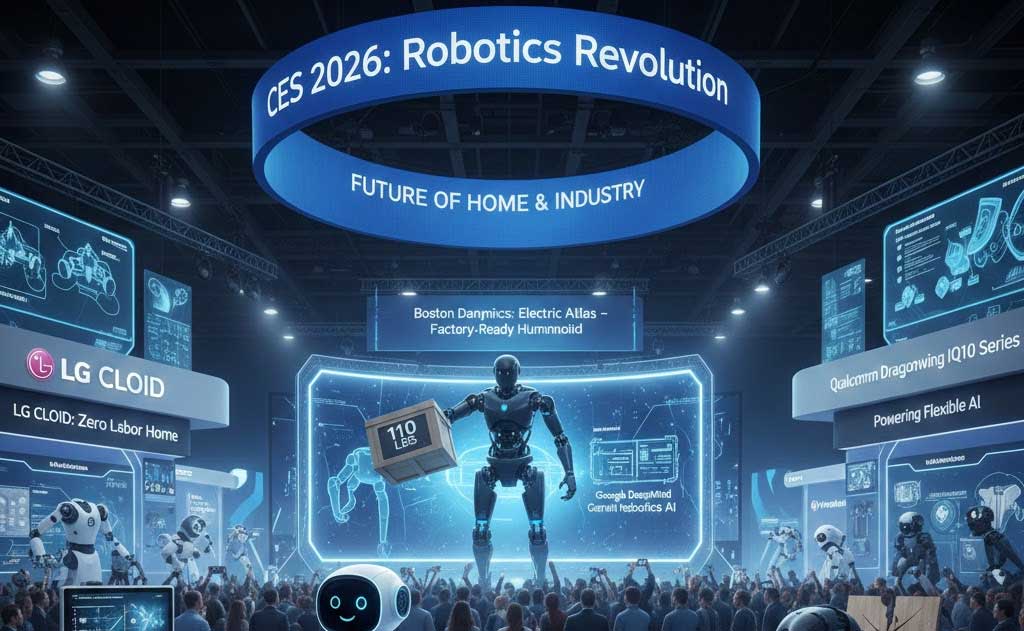
CES 2026 is proving to be the year robotics truly breaks out, with humanoid robots at CES 2026 stealing the spotlight alongside advanced home assistants. From industrial powerhouses to empathetic household helpers, the CES 2026 robotics trend showcases physical AI moving from labs into factories and living rooms. Major players like LG, Qualcomm, and Boston Dynamics are leading the charge, demonstrating robots that walk, manipulate objects, and collaborate with humans like never before.
The Breakout Trend: Humanoids Go Mainstream
This year’s show floor is buzzing with embodied AI. Nvidia highlighted simulation-trained systems, while a dedicated K-Humanoid Alliance pavilion features dozens of South Korean innovations. But the real stars are full-sized humanoids tackling real-world tasks—from factory assembly to household chores—powered by advanced edge AI and reinforcement learning.
LG CLOiD: Pioneering the “Zero Labor Home”
LG’s standout reveal is the LG CLOiD robot, a wheeled humanoid designed as the centerpiece of its “Zero Labor Home” vision. Equipped with two articulated arms (seven degrees of freedom each), five-fingered dexterous hands, and a head unit packed with cameras, sensors, and a display for expressive interaction, CLOiD handles everyday chores with impressive finesse.
In live demos, it folded laundry, loaded/unloaded dishwashers, retrieved items from appliances, and even prepared simple meals—all while coordinating with LG’s ThinQ-connected ecosystem. Powered by Affectionate Intelligence, CLOiD learns routines, detects context, and adapts responses for personalized support. This makes it one of the most practical home assistants at CES 2026, promising relief for busy households and aging populations.
Qualcomm Dragonwing IQ10: Powering Flexible, Bendy Humanoids
Qualcomm entered the robotics arena with the Dragonwing IQ10 Series, a full-stack AI platform blending hardware, software, and edge computing for energy-efficient, scalable robots—from compact helpers to full humanoids.
The highlight: Partnership with VinMotion on the Motion 2 humanoid, which demonstrated extreme flexibility—bending backward to pick up objects or even punching through wood. Designed for perception, navigation, and manipulation, Dragonwing IQ10 targets industrial and general-purpose applications, with ecosystem partners like Figure AI and Booster Robotics accelerating deployment.
Boston Dynamics’ New Electric Atlas: Factory-Ready Humanoid
Hyundai and Boston Dynamics delivered one of CES’s most thrilling moments: The public debut of the production-ready electric Atlas. This all-electric evolution replaces hydraulics with precise, 360-degree rotating joints, enabling fluid, human-like gait and complex movements.
Atlas strutted onstage with a jaunty walk, showcasing strength (lifting 110 pounds), durability (IP67-rated), and advanced capabilities like autonomous battery swapping. Backed by a new partnership with Google DeepMind for Gemini Robotics AI foundation models, Atlas is set for industrial deployment—starting at Hyundai factories in 2028, with initial fleets shipping in 2026.
Comparisons: Home vs. Industrial Humanoids
- LG CLOiD: Wheeled base for stability, focus on delicate home tasks (laundry, dishes). Best for consumer “Zero Labor” scenarios.
- Qualcomm-powered Motion 2: Extreme flexibility and strength demos; suited for dynamic environments.
- Boston Dynamics Atlas: Bipedal, highly athletic motion; industrial-grade with factory applications first.
While home-focused robots like CLOiD emphasize empathy and integration, industrial ones like Atlas prioritize reliability and heavy lifting.
Real-World Applications and 2026 Implications
These humanoid robots CES 2026 unveilings signal rapid progress:
- Factories: Atlas and similar bots will collaborate on assembly lines, boosting efficiency and safety.
- Homes: CLOiD-style assistants could combat isolation, assist elderly users, and handle repetitive chores.
- Broader Impact: Agentic AI enables proactive task-planning, while edge processing ensures privacy and low latency.
Experts predict 2026 as a tipping point: Affordable platforms like Dragonwing IQ10 will spur wider adoption, with consumer home robots potentially launching pilots by late year.
The CES 2026 robotics revolution isn’t just flashy demos—it’s laying groundwork for robots as everyday partners. Stay tuned to VFutureMedia for hands-on updates, reviews, and predictions as these innovations hit the market. The future of human-robot collaboration is here, and it’s walking among us.
We started VFuture Media because we wanted tech news written by people who actually follow this industry — not content farms chasing keywords. If that resonates, we’d love to have you as a regular reader. Pull up a chair.



Leave a Comment